

Supplementary Files
Keywords
modelling human systems
natural landscape management
sustainability
socio-ecological systems
How to Cite
Abstract
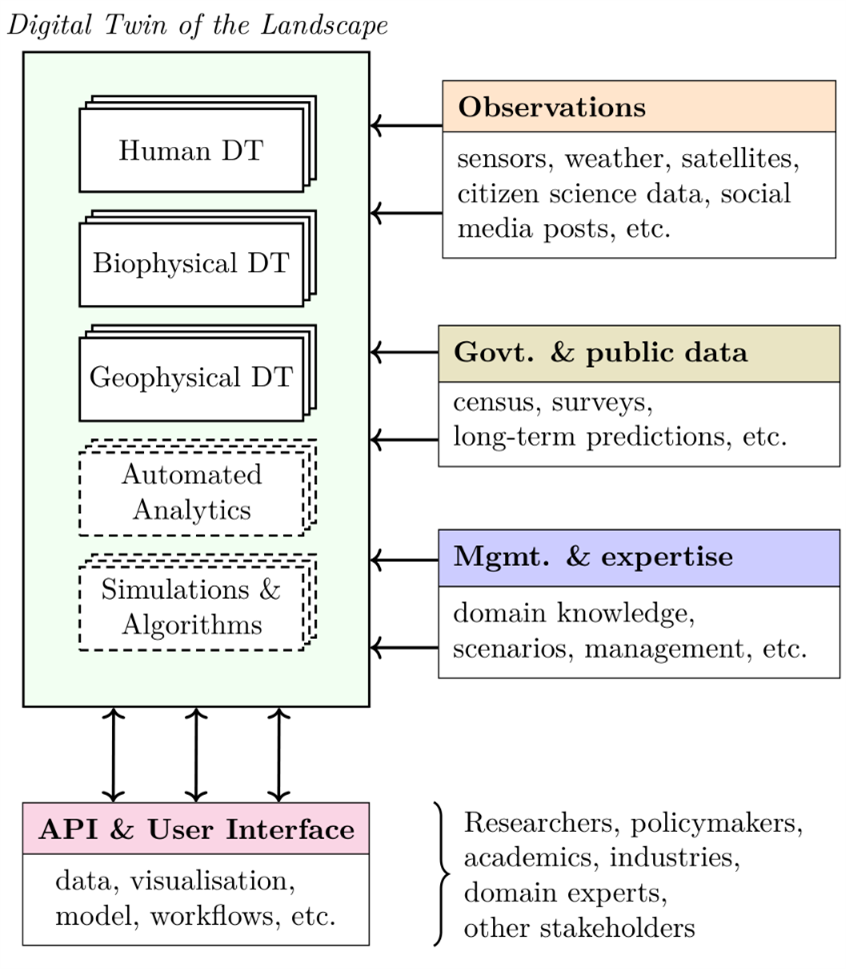
Digital Twins (DTs) are dynamic digital representations of physical objects and systems, including their associated processes and environments. Using real-time data analytics, modelling, simulation and ‘what-if’ scenarios, they can enable valuable understanding and decision-support for managing a system. One potential application of DTs is the management of natural landscapes. However, despite the critical impact of humans on the natural environment, none of the DTs of the natural environment found in the literature include the human systems in that environment. We propose a modular framework for integrating human systems within a DT of the natural environment, to facilitate simulation and modelling of a range of management contexts, objectives and stakeholders across time and space. We then propose four principles as the theoretical basis for modelling the socio-ecological governance systems that underpin DTs of human systems for managing the natural environment. We also provide a use case related to area-wide integrated pest management as an example of the potential application of the proposed framework for collectively managing the natural landscape. The composition and characteristics of this use case as a DT and examples of user engagement at multiple spatial and temporal scales are also described. Finally, we identify some methods such as agent-based modelling, reinforcement learning, and graph neural networks that could be used to incorporate human systems in a DT, along with some examples of their use for similar tasks from the literature. Integrating human systems in DTs of the natural environment will facilitate the development of novel digital decision-support tools that provide stakeholders with different perspectives of the shared natural environment and enable them to understand the impact of various management methods and actions.
References
Abdulkareem, S. A., Mustafa, Y. T., Augustijn, E.-W., & Filatova, T. (2019). Bayesian networks for spatial learning: A workflow on using limited survey data for intelligent learning in spatial agent-based models. GeoInformatica, 23(2), 243–268. https://doi.org/10.1007/s10707-019-00347-0
Aggarwal, R., & Anderies, J. (2023). Understanding how governance emerges in social-ecological systems: Insights from archetype analysis. Ecology and Society, 28(2). https://doi.org/10.5751/es-14061-280202
Ale Ebrahim Dehkordi, M., Lechner, J., Ghorbani, A., Nikolic, I., Chappin, É., & Herder, P. (2023). Using Machine Learning for Agent Specifications in Agent-Based Models and Simulations: A Critical Review and Guidelines. Journal of Artificial Societies and Social Simulation, 26(1), 9. https://doi.org/10.18564/jasss.5016
Alves, R. G., Maia, R. F., & Lima, F. (2023). Development of a Digital Twin for Smart Farming: Irrigation Management System for Water Saving. Journal of Cleaner Production, 388, 135920. https://doi.org/10.1016/j.jclepro.2023.135920
An, L., Grimm, V., Bai, Y., Sullivan, A., Turner, B. L., Malleson, N., Heppenstall, A., Vincenot, C., Robinson, D., Ye, X., Liu, J., Lindkvist, E., & Tang, W. (2023). Modeling agent decision and behavior in the light of data science and artificial intelligence. Environmental Modelling & Software, 166, 105713. https://doi.org/10.1016/j.envsoft.2023.105713
Angione, C., Silverman, E., & Yaneske, E. (2022). Using machine learning as a surrogate model for agent-based simulations. Plos One, 17(2), e0263150. https://doi.org/gqk2qb
Annoni, A., Nativi, S., Çöltekin, A., Desha, C., Eremchenko, E., Gevaert, C. M., Giuliani, G., Chen, M., Perez-Mora, L., Strobl, J., & Tumampos, S. (2023). Digital earth: Yesterday, today, and tomorrow. In International Journal of Digital Earth (Vol. 16, Issue 1, pp. 1022–1072). https://doi.org/10.1080/17538947.2023.2187467
Bauer, P., Stevens, B., & Hazeleger, W. (2021). A Digital Twin of Earth for the Green Transition. Nature Climate Change, 11(2), 80–83. https://doi.org/ghxtwv
Bell, S., & Park, A. (2006). The Problematic Metagovernance of Networks: Water Reform in New South Wales. Journal of Public Policy, 26(1), 63–83. https://doi.org/dkw3pg
Birks, D., Heppenstall, A., & Malleson, N. (2020). Towards the Development of Societal Twins. In ECAI 2020 (pp. 2883–2884). IOS Press.
Blair, G. S. (2021). Digital Twins of the Natural Environment. Patterns, 2(10), 100359. https://doi.org/10.1016/j.patter.2021.100359
Bonabeau, E. (2002). Agent-based modeling: Methods and techniques for simulating human systems. Proceedings of the National Academy of Sciences, 99(suppl 3), 7280–7287.
Bourceret, A., Amblard, L., & Mathias, J.-D. (2021). Governance in social-ecological agent-based models: A review. Ecology and Society, 26(2), art38. https://doi.org/nsbm
Buonocore, L., Yates, J., & Valentini, R. (2022). A Proposal for a Forest Digital Twin Framework and Its Perspectives. Forests, 13(4), 498. https://doi.org/10.3390/f13040498
Calvin, K., & Bond-Lamberty, B. (2018). Integrated Human-Earth System Modeling—State of the Science and Future Directions. Environmental Research Letters, 13(6), 063006. https://doi.org/10.1088/1748-9326/aac642
Castelli, G., Cesta, A., Diez, M., Padula, M., Ravazzani, P., Rinaldi, G., Savazzi, S., Spagnuolo, M., Strambini, L., Tognola, G., & Campana, E. F. (2019). Urban Intelligence: A Modular, Fully Integrated, and Evolving Model for Cities Digital Twinning. 2019 IEEE 16th International Conference on Smart Cities; Improving Quality of Life Using ICT, IOT and AI (IEEE HONET-ICT 2019), 33–37.
Chen, H., Fang, C., & Xiao, X. (2023). Visualization of Environmental Sensing Data in the Lake-Oriented Digital Twin World: Poyang Lake as an Example. REMOTE SENSING, 15(5). https://doi.org/10.3390/rs15051193
Cheshire, L., Everingham, J.-A., & Lawrence, G. (2014). Governing the impacts of mining and the impacts of mining governance: Challenges for rural and regional local governments in Australia. Journal of Rural Studies, 36, 330–339. https://doi.org/nsbn
Chopra, A., Raskar, R., Subramanian, J., Krishnamurthy, B., Gel, E. S., Romero-Brufau, S., Pasupathy, K. S., & Kingsley, T. C. (2021). DeepABM: Scalable and Efficient Agent-Based Simulations Via Geometric Learning Frameworks - a Case Study For Covid-19 Spread and Interventions. 2021 Winter Simulation Conference (WSC), 1–12. https://doi.org/nsbp
Chopra, A., Rodriguez, A., Prakash, B. A., Raskar, R., & Kingsley, T. (2023). Using neural networks to calibrate agent based models enables improved regional evidence for vaccine strategy and policy. Vaccine, 41(48), 7067–7071. https://doi.org/nsbq
Cowan, R., & Gunby, P. (1996). Sprayed to death: Path dependence, lock-in and pest control strategies. The Economic Journal, 106(436), 521–542.
Deguine, J.-P., Aubertot, J.-N., Flor, R. J., Lescourret, F., Wyckhuys, K. A., & Ratnadass, A. (2021). Integrated pest management: Good intentions, hard realities. A review. Agronomy for Sustainable Development, 41(3), 38.
Dyer, J., Cannon, P., Farmer, J. D., & Schmon, S. M. (2022). Calibrating agent-based models to microdata with graph neural networks. ICML Workshop AI for Agent-Based Modelling (Best Proposal Paper). https://openreview.net/forum?id=ZWyHGTUcgJD
Epstein, J. M. (2006). Generative social science: Studies in agent-based computational modeling. Princeton University Press.
Eramo, R., Bordeleau, F., Combemale, B., Brand, M. van den, Wimmer, M., & Wortmann, A. (2022). Conceptualizing Digital Twins. In IEEE Software (Vol. 39, Issue 2, pp. 39–46). https://doi.org/10.1109/MS.2021.3130755
Everingham, J.-A. (2009). Australia’s Regions. Public Policy and Administration, 24(1), 84–102. https://doi.org/10.1177/0952076708097910
Fan, C., Zhang, C., Yahja, A., & Mostafavi, A. (2021). Disaster City Digital Twin: A Vision for Integrating Artificial and Human Intelligence for Disaster Management. International Journal of Information Management, 56, 102049. https://doi.org/ggj8kw
Ferko, E., Bucaioni, A., & Behnam, M. (2022). Architecting Digital Twins. In IEEE Access (Vol. 10, pp. 50335–50350). https://doi.org/10.1109/ACCESS.2022.3172964
Fuller, A., Fan, Z., Day, C., & Barlow, C. (2020). Digital Twin: Enabling Technologies, Challenges and Open Research. In IEEE Access (Vol. 8, pp. 108952–108971). https://doi.org/10.1109/ACCESS.2020.2998358
Gjaltema, J., Biesbroek, R., & Termeer, K. (2019). From government to governance to meta-governance: A systematic literature review. Public Management Review, 22(12), 1760–1780. https://doi.org/10.1080/14719037.2019.1648697
Graham, S., Metcalf, A. L., Gill, N., Niemiec, R., Moreno, C., Bach, T., Ikutegbe, V., Hallstrom, L., Ma, Z., & Lubeck, A. (2019). Opportunities for better use of collective action theory in research and governance for invasive species management. Conservation Biology, 33(2), 275–287. https://doi.org/10.1111/cobi.13266
Halik, A., Verweij, M., & Schlüter, A. (2018). How Marine Protected Areas Are Governed: A Cultural Theory Perspective. Sustainability, 10(1), 252. https://doi.org/gc4czp
Jäger, G. (2019). Replacing Rules by Neural Networks A Framework for Agent-Based Modelling. Big Data and Cognitive Computing, 3(4), 51. https://doi.org/gpf7f7
Janssen, S., Sharpanskykh, A., Curran, R., & Langendoen, K. (2019). Using causal discovery to analyze emergence in agent-based models. Simulation Modelling Practice and Theory, 96, 101940. https://doi.org/10.1016/j.simpat.2019.101940
Jones, D., Snider, C., Nassehi, A., Yon, J., & Hicks, B. (2020). Characterising the Digital Twin: A Systematic Literature Review. CIRP Journal of Manufacturing Science and Technology, 29, 36–52. https://doi.org/10.1016/j.cirpj.2020.02.002
Kaelbling, L. P., Littman, M. L., & Moore, A. W. (1996). Reinforcement learning: A survey. Journal of Artificial Intelligence Research, 4, 237–285.
Knibbe, W. J., Afman, L., Boersma, S., Bogaardt, M.-J., Evers, J., van Evert, F., van hder Heide, J., Hoving, I., van Mourik, S., de Ridder, D., & de Wit, A. (2022). Digital Twins in the Green Life Sciences. NJAS: Impact in Agricultural and Life Sciences, 94(1), 249–279. https://doi.org/10.1080/27685241.2022.2150571
Kogan, M. (1998). Integrated Pest Management: Historical Perspectives and Contemporary Developments. Annual Review of Entomology, 43(1), 243–270. https://doi.org/fj79gf
Koning, K. de, Broekhuijsen, J., Kühn, I., Ovaskainen, O., Taubert, F., Endresen, D., Schigel, D., & Grimm, V. (2023). Digital Twins: Dynamic Model-Data Fusion for Ecology. Trends in Ecology & Evolution, 38(10), 916-926. https://doi.org/10.1016/j.tree.2023.04.010
Kobayashi, K., & Alam, S. B. (2024). Explainable, interpretable, and trustworthy AI for an intelligent digital twin: A case study on remaining useful life. Engineering Applications of Artificial Intelligence, 129, 107620. https://doi.org/10.1016/j.engappai.2023.107620
Kritzinger, W., Karner, M., Traar, G., Henjes, J., & Sihn, W. (2018). Digital Twin in manufacturing: A categorical literature review and classification. IFAC-PapersOnLine, 51(11), 1016–1022. https://doi.org/10.1016/j.ifacol.2018.08.474
Li, X., Feng, M., Ran, Y., Su, Y., Liu, F., Huang, C., Shen, H., Xiao, Q., Su, J., Yuan, S., & Guo, H. (2023). Big Data in Earth system science and progress towards a digital twin. In Nature Reviews Earth and Environment. https://doi.org/10.1038/s43017-023-00409-w
Lilja Bye, B., Sylaios, G., Berre, A.-J., Van Dam, S., & Kiousi, V. (2022). Digital Twin of the Ocean-an Introduction to the ILIAD Project. EGU General Assembly Conference Abstracts, EGU22-12617. https://meetingorganizer.copernicus.org/EGU22/EGU22-12617.html
Macal, C. M. (2016). Everything you need to know about agent-based modelling and simulation. Journal of Simulation, 10(2), 144–156.
Meinzen-Dick, R., DiGregorio, M., & McCarthy, N. (2004). Methods for studying collective action in rural development. Agricultural Systems, 82(3), 197–214. https://doi.org/cbfnwc
Meuleman, L. (2009). The Cultural Dimension of Metagovernance: Why Governance Doctrines May Fail. Public Organization Review, 10(1), 49–70. https://doi.org/bv4b66
Moshrefzadeh, M., Machl, T., Gackstetter, D., Donaubauer, A., & Kolbe, T. H. (2020). Towards a Distributed Digital Twin of the Agricultural Landscape. Journal of Digital Landscape Architecture, 5, 173–186. https://doi.org/10.14627/537690019
Mostafa, F., Tao, L., & Yu, W. (2021). An Effective Architecture of Digital Twin System to Support Human Decision Making and AI-driven Autonomy. Concurrency and Computation: Practice and Experience, 33(19, SI). https://doi.org/10.1002/cpe.6111
Motesharrei, S., Rivas, J., Kalnay, E., Asrar, G. R., Busalacchi, A. J., Cahalan, R. F., Cane, M. A., Colwell, R. R., Feng, K., Franklin, R. S., Hubacek, K., Miralles-Wilhelm, F., Miyoshi, T., Ruth, M., Sagdeev, R., Shirmohammadi, A., Shukla, J., Srebric, J., Yakovenko, V. M., & Zeng, N. (2016). Modeling Sustainability: Population, Inequality, Consumption, and Bidirectional Coupling of the Earth and Human Systems. National Science Review, 3(4), 470–494. https://doi.org/10.1093/nsr/nww081
Mustafa, A., Cools, M., Saadi, I., & Teller, J. (2017). Coupling agent-based, cellular automata and logistic regression into a hybrid urban expansion model (HUEM). Land Use Policy, 69, 529–540. https://doi.org/10.1016/j.landusepol.2017.10.009
Naqvi, A. A., & Rehm, M. (2014). A multi-agent model of a low income economy: Simulating the distributional effects of natural disasters. Journal of Economic Interaction and Coordination, 9(2), 275–309.
Nativi, S., Mazzetti, P., & Craglia, M. (2021). Digital Ecosystems for Developing Digital Twins of the Earth: The Destination Earth Case. Remote Sensing, 13(11), 2119. https://doi.org/10.3390/rs13112119
Nita, M. D. (2021). Testing Forestry Digital Twinning Workflow Based on Mobile LiDAR Scanner and AI Platform. FORESTS, 12(11). https://doi.org/10.3390/f12111576
Ostrom, E. (1990). Governing the Commons: The Evolution of Institutions for Collective Action. Cambridge University Press. https://doi.org/10.1017/cbo9780511807763
Palmer, P. I., & Smith, M. J. (2014). Earth Systems: Model Human Adaptation to Climate Change. Nature, 512(7515), 365–366. https://doi.org/10.1038/512365a
Park, D., & You, H. (2023). A Digital Twin Dam and Watershed Management Platform. Water, 15(11), 2106. https://doi.org/10.3390/w15112106
Park, J., & Yang, B. (2020). GIS-Enabled Digital Twin System for Sustainable Evaluation of Carbon Emissions: A Case Study of Jeonju City, South Korea. SUSTAINABILITY, 12(21). https://doi.org/10.3390/su12219186
Peters, R., Lin, Y., & Berger, U. (2016). Machine learning meets individual-based modelling: Self-organising feature maps for the analysis of below-ground competition among plants. Ecological Modelling, 326, 142–151. https://doi.org/10.1016/j.ecolmodel.2015.10.014
Platas‐López, A., Guerra‐Hernández, A., Quiroz‐Castellanos, M., & Cruz‐Ramirez, N. (2023). A survey on agent‐based modelling assisted by machine learning. Expert Systems, e13325. https://doi.org/10.1111/exsy.13325
Pretty, J. (2018). Intensification for redesigned and sustainable agricultural systems. Science, 362(6417), eaav0294. https://doi.org/10.1126/science.aav0294
Purcell, W., & Neubauer, T. (2023). Digital Twins in Agriculture: A State-of-the-art review. Smart Agricultural Technology, 3, 100094. https://doi.org/10.1016/j.atech.2022.100094
Qiu, Y., Duan, H., Xie, H., Ding, X., & Jiao, Y. (2022). Design and Development of a Web-Based Interactive Twin Platform for Watershed Management. Transactions in GIS, 26(3), 1299–1317. https://doi.org/10.1111/tgis.12904
Radanliev, P., De Roure, D., Nicolescu, R., Huth, M., & Santos, O. (2022). Digital twins: Artificial intelligence and the IoT cyber-physical systems in Industry 4.0. In International Journal of Intelligent Robotics and Applications (Vol. 6, Issue 1, pp. 171–185). https://doi.org/10.1007/s41315-021-00180-5
Ravid, B. Y., & Aharon-Gutman, M. (2023). The Social Digital Twin:The Social Turn in the Field of Smart Cities. Environment and Planning B: Urban Analytics and City Science, 50(6), 1455–1470. https://doi.org/10.1177/23998083221137079
Ruzol, C., Banzon-Cabanilla, D., Ancog, R., & Peralta, E. (2017). Understanding water pollution management: Evidence and insights from incorporating cultural theory in social network analysis. Global Environmental Change, 45, 183–193. https://doi.org/nsbs
Sánchez-Maroño, N., Alonso-Betanzos, A., Fontenla-Romero, O., Polhill, J. G., & Craig, T. (2017). Empirically-Derived Behavioral Rules in Agent-Based Models Using Decision Trees Learned from Questionnaire Data. In A. Alonso-Betanzos, N. Sánchez-Maroño, O. Fontenla-Romero, J. G. Polhill, T. Craig, J. Bajo, & J. M. Corchado (Eds.), Agent-Based Modeling of Sustainable Behaviors (pp. 53–76). Springer International Publishing. https://doi.org/10.1007/978-3-319-46331-5_3
Scarselli, F., Gori, M., Tsoi, A. C., Hagenbuchner, M., & Monfardini, G. (2009). The Graph Neural Network Model. IEEE Transactions on Neural Networks, 20(1), 61–80. https://doi.org/10.1109/TNN.2008.2005605
Sert, E., Bar-Yam, Y., & Morales, A. J. (2020). Segregation dynamics with reinforcement learning and agent based modeling. Scientific Reports, 10(1), 11771.
Trantas, A., Plug, R., Pileggi, P., & Lazovik, E. (2023). Digital twin challenges in biodiversity modelling. In Ecological Informatics (Vol. 78). https://doi.org/gtprjr
Uhlenkamp, J.-F., Hauge, J. B., Broda, E., Lütjen, M., Freitag, M., & Thoben, K.-D. (2022). Digital Twins: A Maturity Model for Their Classification and Evaluation. IEEE Access, 10, 69605–69635. IEEE Access. https://doi.org/10.1109/ACCESS.2022.3186353
van der Burg, S., Kloppenburg, S., Kok, E. J., & van der Voort, M. (2021). Digital Twins in Agri-Food: Societal and Ethical Themes and Questions for Further Research. NJAS: Impact in Agricultural and Life Sciences, 93(1), 98–125. https://doi.org/nsbr
Verdouw, C., Tekinerdogan, B., Beulens, A., & Wolfert, S. (2021). Digital Twins in Smart Farming. Agricultural Systems, 189, 103046. https://doi.org/10.1016/j.agsy.2020.103046
Voosen, P. (2020). Europe builds ‘digital twin’ of earth to hone climate forecasts. In Science (Vol. 370, Issue 6512, pp. 16–17). https://doi.org/10.1126/science.370.6512.16
Xu, Z., Jiang, T., & Zheng, N. (2022). Developing and Analyzing Eco-Driving Strategies for on-Road Emission Reduction in Urban Transport Systems-A VR-enabled Digital-Twin Approach. CHEMOSPHERE, 305(135372). https://doi.org/gqk2jp
Zhang, W., Valencia, A., & Chang, N.-B. (2023). Synergistic Integration Between Machine Learning and Agent-Based Modeling: A Multidisciplinary Review. IEEE Transactions on Neural Networks and Learning Systems, 34(5), 2170–2190. IEEE Transactions on Neural Networks and Learning Systems. https://doi.org/10.1109/TNNLS.2021.3106777
Zhou, J., Cui, G., Hu, S., Zhang, Z., Yang, C., Liu, Z., Wang, L., Li, C., & Sun, M. (2020). Graph neural networks: A review of methods and applications. AI Open, 1, 57–81. https://doi.org/gjt96x

This work is licensed under a Creative Commons Attribution-NonCommercial 4.0 International License.
Copyright (c) 2026 Sandeep Dhakal, Hazel Parry, Yayong Li, Barton Loechel, Peyman Moghadam