

Keywords
multiscale modelling
social-ecological systems
cascading effects
cross-scale interactions
How to Cite
Abstract
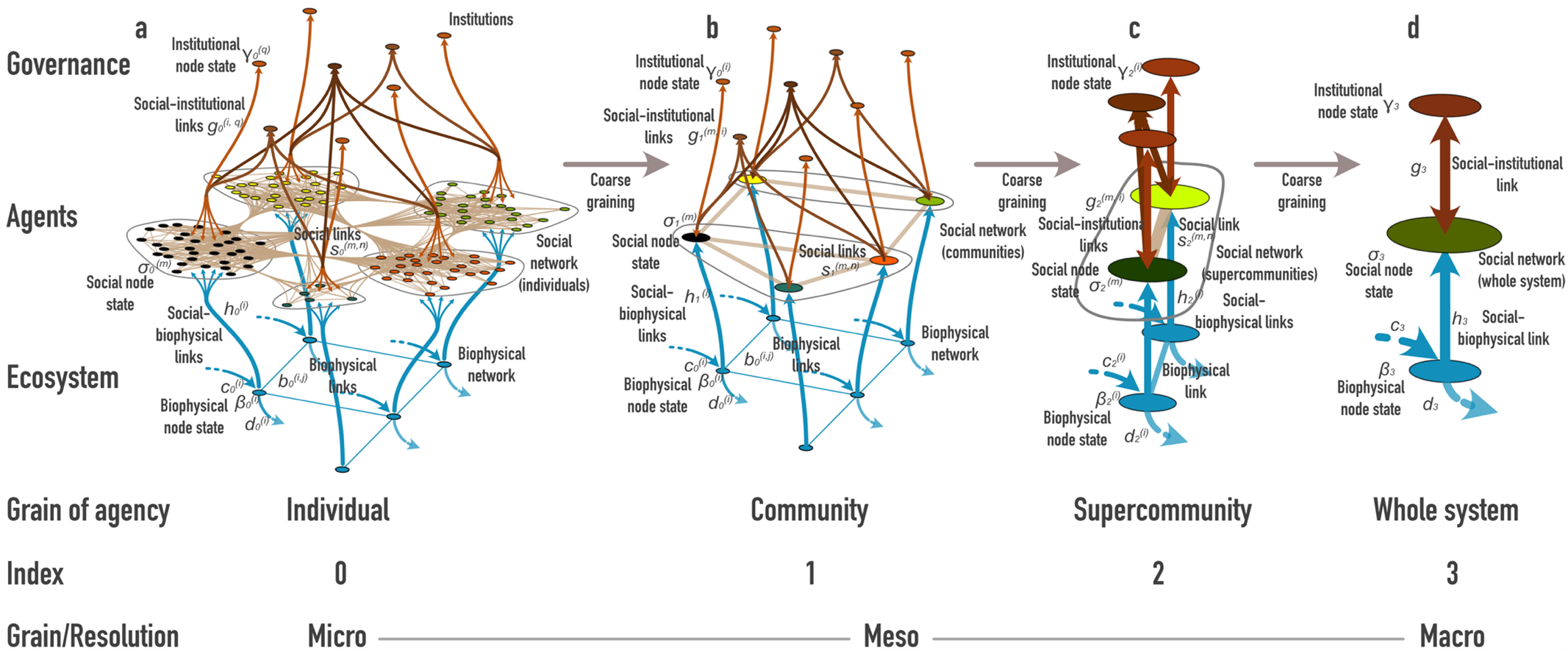
Social-ecological systems (SESs) are complex adaptive systems that encompass multiple spatial, temporal, and organisational scales and levels. The dynamics of SESs are driven by interactions among processes occurring both within and across different levels. These multi-level interactions generate patterns of system behaviour that emerge at different spatial, temporal, and organisational levels. This has profound implications for managing SESs. Agent-based models (ABMs) are known for their ability to simulate emergent phenomena and are powerful tools for modelling SESs. However, most multi-level ABMs focus merely on individual/micro-level interactions and aggregated/macro-level interactions and rarely capture the true multi-level dynamics of SESs, which often include effects that cascade across multiple levels. We describe a conceptual framework for multi-level ABMs that couple processes occurring at intermediate levels with those occurring at micro and macro levels, and, more importantly, propose a mathematical construct that embodies the generic features of a truly multi-level ABM. We then discuss our proposed model within the context of past and potential future multi-level agent-based modelling efforts.
References
Amorocho-Daza, H., Sušnik, J., van der Zaag, P., & Slinger, J. H. (2025). A model-based policy analysis framework for social-ecological systems: Integrating uncertainty and participation in system dynamics modelling. Ecological Modelling, 499, 110943.
An, L., Linderman, M., Qi, J., Shortridge, A., & Liu, J. (2005). Exploring Complexity in a Human–Environment System: An Agent-Based Spatial Model for Multidisciplinary and Multiscale Integration. Annals of the Association of American Geographers, 95(1), 54-79. https://doi.org/10.1111/j.1467-8306.2005.00450.x
Audzijonyte, A., Pethybridge, H., Porobic, J., Gorton, R., Kaplan, I., & Fulton, E. A. (2019). Atlantis: A spatially explicit end-to-end marine ecosystem model with dynamically integrated physics, ecology and socio-economic modules. Methods in Ecology and Evolution, 10(10), 1814-1819. https://doi.org/https://doi.org/10.1111/2041-210X.13272
Banisch, S. (2016). Markov Chain Aggregation for Agent-Based Models. Springer International Publishing. http://link.springer.com/10.1007/978-3-319-24877-6
Barbrook-Johnson, P., van Voorn, G., Wang, H.-H., Zare, F., Grant, W. E., Posnik, Z., & Lippe, M. (2024). Cross-scale feedbacks and tipping points in aggregated models of socio-ecological systems. Socio-Environmental Systems Modelling, 6, 18616-18616.
Berger, C., Bieri, M., Bradshaw, K., Brümmer, C., Clemen, T., Hickler, T., Kutsch, W. L., Lenfers, U. A., Martens, C., Midgley, G. F., Mukwashi, K., Odipo, V., Scheiter, S., Schmullius, C., Baade, J., du Toit, J. C. O., Scholes, R. J., Smit, I. P. J., Stevens, N., & Twine, W. (2019). Linking scales and disciplines: an interdisciplinary cross-scale approach to supporting climate-relevant ecosystem management. Climatic Change, 156(1), 139-150. https://doi.org/10.1007/s10584-019-02544-0
Bialozyt, R. B., Roß-Nickoll, M., Ottermanns, R., & Jetzkowitz, J. (2025). The different ways to operationalise the social in applied models and simulations of sustainability science: A contribution for the enhancement of good modelling practices. Ecological Modelling, 500, 110952.
Broomell, S. B., & Kane, P. B. (2021). Perceiving a pandemic: Global–local incompatibility and COVID-19 superspreading events. Decision, 8(4), 227-236. https://doi.org/10.1037/dec0000155
Brown, C., Seo, B., & Rounsevell, M. (2019). Societal breakdown as an emergent property of large-scale behavioural models of land use change. Earth Syst. Dynam., 10(4), 809-845. https://doi.org/10.5194/esd-10-809-2019
Brugière, A., Nguyen-Ngoc, D., & Drogoul, A. (2022). Handling multiple levels in agent-based models of complex socio-environmental systems: A comprehensive review. Frontiers in Applied Mathematics and Statistics, 8. https://doi.org/10.3389/fams.2022.1020353
Caillault, S., Mialhe, F., Vannier, C., Delmotte, S., Kêdowidé, C., Amblard, F., Etienne, M., Bécu, N., Gautreau, P., & Houet, T. (2013). Influence of incentive networks on landscape changes: A simple agent-based simulation approach. Environmental modelling & software, 45, 64-73. https://doi.org/https://doi.org/10.1016/j.envsoft.2012.11.003
Cash, D. W., Adger, W. N., Berkes, F., Garden, P., Lebel, L., Olsson, P., Pritchard, L., & Young, O. (2006). Scale and cross-scale dynamics: governance and information in a multilevel world. Ecology and Society, 11(2).
Champion, K., Lusch, B., Kutz, J. N., & Brunton, S. L. (2019). Data-driven discovery of coordinates and governing equations. Proceedings of the national Academy of sciences, 116(45), 22445-22451. https://doi.org/10.1073/pnas.1906995116
Chopard, B., Borgdorff, J., & Hoekstra, A. G. (2014). A framework for multi-scale modelling. Philosophical transactions. Series A, Mathematical, physical, and engineering sciences, 372(2021), 20130378. https://doi.org/10.1098/rsta.2013.0378
Cleveland, W. S., & Devlin, S. J. (1988). Locally Weighted Regression: An Approach to Regression Analysis by Local Fitting. Journal of the American Statistical Association, 83(403), 596-610. https://doi.org/10.1080/01621459.1988.10478639
Cumming, G. S. (2016). Heterarchies: Reconciling Networks and Hierarchies. Trends in Ecology & Evolution, 31(8), 622-632. https://doi.org/10.1016/j.tree.2016.04.009
Cumming, G. S., Morrison, T. H., & Hughes, T. P. (2017). New Directions for Understanding the Spatial Resilience of Social–Ecological Systems. Ecosystems, 20(4), 649-664. https://doi.org/10.1007/s10021-016-0089-5
Dada, J. O., & Mendes, P. (2011). Multi-scale modelling and simulation in systems biology. Integrative Biology, 3(2), 86-96. https://doi.org/10.1039/c0ib00075b
DeFries, R., & Nagendra, H. (2017). Ecosystem management as a wicked problem. Science, 356(6335), 265-270. https://doi.org/doi:10.1126/science.aal1950
Donovan, M. K., Alves, C., Burns, J., Drury, C., Meier, O. W., Ritson-Williams, R., Cunning, R., Dunn, R. P., Goodbody-Gringley, G., Henderson, L. M., Knapp, I. S. S., Levy, J., Logan, C. A., Mudge, L., Sullivan, C., Gates, R. D., & Asner, G. P. (2023). From polyps to pixels: understanding coral reef resilience to local and global change across scales. Landscape Ecology, 38(3), 737-752. https://doi.org/10.1007/s10980-022-01463-3
Dou, Y., Millington, J. D. A., Bicudo Da Silva, R. F., McCord, P., Viña, A., Song, Q., Yu, Q., Wu, W., Batistella, M., Moran, E., & Liu, J. (2019). Land-use changes across distant places: design of a telecoupled agent-based model. Journal of Land Use Science, 14(3), 191-209. https://doi.org/10.1080/1747423X.2019.1687769
Dressler, G., Groeneveld, J., Hetzer, J., Janischewski, A., Nolzen, H., Rodig, E., Schwarz, N., Taubert, F., Thober, J., Will, M., Williams, T., Wirth, S. B., & Muller, B. (2022). Upscaling in socio-environmental systems modelling: Current challenges, promising strategies and insights from ecology. Socio-Environmental Systems Modelling, 4, 18112-18112. https://doi.org/10.18174/sesmo.18112
E, W., Engquist, B., & Huang, Z. (2003). Heterogeneous multiscale method: A general methodology for multiscale modeling. Physical Review B, 67(9), 092101. https://doi.org/10.1103/PhysRevB.67.092101
Elsawah, S., Filatova, T., Jakeman, A. J., Kettner, A. J., Zellner, M. L., Athanasiadis, I. N., Hamilton, S. H., Axtell, R. L., Brown, D. G., Gilligan, J. M., Janssen, M. A., Robinson, D. T., Rozenberg, J., Ullah, I. I. T., & Lade, S. J. (2020). Eight grand challenges in socio-environmental systems modeling. Socio-Environmental Systems Modelling, 2, 16226. https://doi.org/10.18174/sesmo.2020a16226
Engquist, B., Li, X., Ren, W., & Vanden-Eijnden, E. (2007). Heterogeneous multiscale methods: a review. Communications in Computational Physics, 2(3), 367-450.
Ewert, F., van Ittersum, M. K., Heckelei, T., Therond, O., Bezlepkina, I., & Andersen, E. (2011). Scale changes and model linking methods for integrated assessment of agri-environmental systems. Agriculture, Ecosystems & Environment, 142(1), 6-17. https://doi.org/https://doi.org/10.1016/j.agee.2011.05.016
Filatova, T., Verburg, P. H., Parker, D. C., & Stannard, C. A. (2013). Spatial agent-based models for socio-ecological systems: Challenges and prospects. Environmental modelling & software, 45, 1-7.
Gear, C. W., Hyman, J. M., Kevrekidid, P. G., Kevrekidis, I. G., Runborg, O., & Theodoropoulos, C. (2003). Equation-Free, Coarse-Grained Multiscale Computation: Enabling Macroscopic Simulators to Perform System-Level Analysis. Communications in Mathematical Sciences, 1(4), 715-762. https://projecteuclid.org/journals/communications-in-mathematical-sciences/volume-1/issue-4/Equation-Free-Coarse-Grained-Multiscale-Computation--Enabling-Mocroscopic-Simulators/cms/1119655353.full
Gibson, C. C., Ostrom, E., & Ahn, T. K. (2000). The concept of scale and the human dimensions of global change: a survey. Ecological Economics, 32(2), 217-239. https://doi.org/https://doi.org/10.1016/S0921-8009(99)00092-0
Grimm, V., Berger, U., DeAngelis, D. L., Polhill, J. G., Giske, J., & Railsback, S. F. (2010). The ODD protocol: a review and first update. Ecological Modelling, 221(23), 2760-2768.
Gunderson, L. H., & Holling, C. S. (2002). Panarchy: understanding transformations in human and natural systems. Island press.
Hadian, S., & Madani, K. (2015). A system of systems approach to energy sustainability assessment: Are all renewables really green? Ecological Indicators, 52, 194-206. https://doi.org/https://doi.org/10.1016/j.ecolind.2014.11.029
Hertel, T. W., West, T. A. P., Börner, J., & Villoria, N. B. (2019). A review of global-local-global linkages in economic land-use/cover change models. Environmental Research Letters, 14(5), 053003. https://doi.org/10.1088/1748-9326/ab0d33
Hipel, K. W., Obeidi, A., Fang, L., & Kilgour, D. M. (2008). Sustainable Environmental Management from a System of Systems Engineering Perspective. In System of Systems Engineering (pp. 443-481). https://doi.org/https://doi.org/10.1002/9780470403501.ch18
Hjorth, A., Head, B., Brady, C., & Wilensky, U. (2020). LevelSpace: A NetLogo Extension for Multi-Level Agent-Based Modeling. Journal of Artificial Societies and Social Simulation, 23(1), 4. https://doi.org/10.18564/jasss.4130
Hooten, M. B., & Hefley, T. (2019). Bringing Bayesian Models to Life. CRC Press.
Iwanaga, T., Steinmann, P., Sadoddin, A., Robinson, D. T., Snow, V., Grimm, V., & Wang, H.-H. (2022). Perspectives on confronting issues of scale in systems modeling. Socio-Environmental Systems Modelling, 4.
Iwanaga, T., Wang, H.-H., Hamilton, S. H., Grimm, V., Koralewski, T. E., Salado, A., Elsawah, S., Razavi, S., Yang, J., Glynn, P., Badham, J., Voinov, A., Chen, M., Grant, W. E., Peterson, T. R., Frank, K., Shenk, G., Barton, C. M., Jakeman, A. J., & Little, J. C. (2021). Socio-technical scales in socio-environmental modeling: Managing a system-of-systems modeling approach. Environmental modelling & software, 135, 104885. https://doi.org/https://doi.org/10.1016/j.envsoft.2020.104885
Iwanaga, T., Wang, H.-H., Koralewski, T. E., Grant, W. E., Jakeman, A. J., & Little, J. C. (2021). Toward a complete interdisciplinary treatment of scale: Reflexive lessons from socioenvironmental systems modeling. Elem Sci Anth, 9(1), 00182.
Jager, W., Janssen, M. A., De Vries, H., De Greef, J., & Vlek, C. (2000). Behaviour in commons dilemmas: Homo economicus and Homo psychologicus in an ecological-economic model. Ecological Economics, 35(3), 357-379.
Jakeman, A. J., Elsawah, S., Wang, H.-H., Hamilton, S. H., Melsen, L., & Grimm, V. (2024). Towards normalizing good practice across the whole modeling cycle: its instrumentation and future research topics. Socio-Environmental Systems Modelling, 6, 18755-18755.
Kavak, H., Padilla, J. J., Lynch, C. J., & Diallo, S. Y. (2018). Big data, agents, and machine learning: towards a data-driven agent-based modeling approach. Proceedings of the Annual Simulation Symposium,
Kevrekidis, I. G., Gear, C. W., & Hummer, G. (2004). Equation‐free: The computer‐aided analysis of complex multiscale systems. AIChE Journal. http://onlinelibrary.wiley.com/doi/10.1002/aic.10106/full
Kleemann, J., Schröter, M., Bagstad, K. J., Kuhlicke, C., Kastner, T., Fridman, D., Schulp, C. J. E., Wolff, S., Martínez-López, J., Koellner, T., Arnhold, S., Martín-López, B., Marques, A., Lopez-Hoffman, L., Liu, J., Kissinger, M., Guerra, C. A., & Bonn, A. (2020). Quantifying interregional flows of multiple ecosystem services – A case study for Germany. Global Environmental Change, 61, 102051. https://doi.org/https://doi.org/10.1016/j.gloenvcha.2020.102051
Lahboub, Y., Bachaoui, E. M., El Harti, A., & El Ghmari, A. (2018). Multi-level Cellular Automata-based housing allocation model for small cities in developing countries: a case study of Kasba-Tadla city, in Morocco. International Journal of Urban Sustainable Development, 10(2), 186-202. https://doi.org/10.1080/19463138.2018.1461628
Lusch, B., Kutz, J. N., & Brunton, S. L. (2018). Deep learning for universal linear embeddings of nonlinear dynamics. Nature Communications, 9(1), 4950. https://doi.org/10.1038/s41467-018-07210-0
Macpherson, E., Cuppari, R. I., Kagawa‐Viviani, A., Brause, H., Brewer, W. A., Grant, W. E., Herman‐Mercer, N., Livneh, B., Neupane, K. R., & Petach, T. (2024). Setting a pluralist agenda for water governance: Why power and scale matter. Wiley Interdisciplinary Reviews: Water, 11(5), e1734.
Malhi, Y., Roberts, J. T., Betts, R. A., Killeen, T. J., Li, W., & Nobre, C. A. (2008). Climate Change, Deforestation, and the Fate of the Amazon. Science, 319(5860), 169-172. https://doi.org/doi:10.1126/science.1146961
McGinnis, M. D., & Ostrom, E. (2014). Social-ecological system framework: initial changes and continuing challenges. Ecology and Society, 19(2), Article 30. https://doi.org/10.5751/ES-06387-190230
Meyer, M., Dou, Y., van Delden, H., Nguyen, T. T., & Lippe, M. (2025). Participation in modeling social-ecological systems across scales in agriculture and forestry. Socio-Environmental Systems Modelling, 7, 18614. https://doi.org/10.18174/sesmo.18614
Moallemi, E. A., Hosseini, S. H., Eker, S., Gao, L., Bertone, E., Szetey, K., & Bryan, B. A. (2022). Acting on Sustainable Development Goal (SDG) synergies and trade-offs requires policy-focused systems tools.
Mrosla, L., Fabritius, H., Kupper, K., Dembski, F., & Fricker, P. (2025). What grows, adapts and lives in the digital sphere? Systematic literature review on the dynamic modelling of flora and fauna in digital twins. Ecological Modelling, 504, 111091.
Müller, B., Hoffmann, F., Heckelei, T., Müller, C., Hertel, T. W., Polhill, J. G., Van Wijk, M., Achterbosch, T., Alexander, P., & Brown, C. (2020). Modelling food security: Bridging the gap between the micro and the macro scale. Global Environmental Change, 63, 102085.
Müller, D., Sun, Z., Vongvisouk, T., Pflugmacher, D., Xu, J., & Mertz, O. (2014). Regime shifts limit the predictability of land-system change. Global Environmental Change, 28, 75-83.
Orioli, S., & Faccioli, P. (2016). Dimensional reduction of Markov state models from renormalization group theory. The Journal of Chemical Physics, 145(12), 124120. https://doi.org/10.1063/1.4963196
Ostrom, E. (2007). A diagnostic approach for going beyond panaceas. Proceedings of the national Academy of sciences, 104(39), 15181-15187.
Paul, E., Brown, G. W., & Ridde, V. (2020). COVID-19: time for paradigm shift in the nexus between local, national and global health. BMJ Global Health, 5(4), e002622. https://doi.org/10.1136/bmjgh-2020-002622
Pelosi, C., Goulard, M., & Balent, G. (2010). The spatial scale mismatch between ecological processes and agricultural management: Do difficulties come from underlying theoretical frameworks? Agriculture, Ecosystems & Environment, 139(4), 455-462.
Perera, D. (2021). Origin and Transmission of Covid-19 as a Negative Outcome of Anthropogenic Ecocide. Journal of Tropical Forestry and Environment, 11(01).
Phillis, Y. A., Kouikoglou, V. S., & Manousiouthakis, V. (2010). A review of sustainability assessment models as system of systems. IEEE Systems Journal, 4(1), 15-25.
Pike, T. (2019). Multi-level mesa. arXiv preprint arXiv:1904.08315.
Preston, B. L., King, A. W., Ernst, K. M., Absar, S. M., Nair, S. S., & Parish, E. S. (2015). Scale and the representation of human agency in the modeling of agroecosystems. Current Opinion in Environmental Sustainability, 14, 239-249. https://doi.org/https://doi.org/10.1016/j.cosust.2015.05.010
Rasmussen, C. E., & Williams, C. K. I. (2005). Gaussian Processes for Machine Learning. The MIT Press. https://direct.mit.edu/books/oa-monograph/2320/Gaussian-Processes-for-Machine-Learning
Ravaioli, G., Domingos, T., & Teixeira, R. F. (2023). Data-driven agent-based modelling of incentives for carbon sequestration: The case of sown biodiverse pastures in Portugal. Journal of Environmental Management, 338, 117834.
Reyers, B., Folke, C., Moore, M.-L., Biggs, R., & Galaz, V. (2018). Social-Ecological Systems Insights for Navigating the Dynamics of the Anthropocene. Annual Review of Environment and Resources, 43(1), 267-289. https://doi.org/10.1146/annurev-environ-110615-085349
Ringsmuth, A. K., Otto, I. M., van den Hurk, B., Lahn, G., Reyer, C. P. O., Carter, T. R., Magnuszewski, P., Monasterolo, I., Aerts, J. C. J. H., Benzie, M., Campiglio, E., Fronzek, S., Gaupp, F., Jarzabek, L., Klein, R. J. T., Knaepen, H., Mechler, R., Mysiak, J., Sillmann, J., . . . West, C. (2022). Lessons from COVID-19 for managing transboundary climate risks and building resilience. Climate Risk Management, 35, 100395. https://doi.org/https://doi.org/10.1016/j.crm.2022.100395
Robinson, D. T., Di Vittorio, A., Alexander, P., Arneth, A., Barton, C. M., Brown, D. G., Kettner, A., Lemmen, C., O'Neill, B. C., Janssen, M., Pugh, T. A. M., Rabin, S. S., Rounsevell, M., Syvitski, J. P., Ullah, I., & Verburg, P. H. (2018). Modelling feedbacks between human and natural processes in the land system. Earth Syst. Dynam., 9(2), 895-914. https://doi.org/10.5194/esd-9-895-2018
Rocha, J. C., Peterson, G., Bodin, Ö., & Levin, S. (2018). Cascading regime shifts within and across scales. Science, 362(6421), 1379-1383.
Rounsevell, M. D. A., Robinson, D. T., & Murray-Rust, D. (2012). From actors to agents in socio-ecological systems models. Philosophical transactions of the Royal Society of London. Series B, Biological sciences, 367(1586), 259-269. https://doi.org/10.1098/rstb.2011.0187
Rutledge, D. T., Cameron, M., Elliott, S., Fenton, T., Huser, B., McBride, G., McDonald, G., O’Connor, M., Phyn, D., Poot, J., Price, R., Scrimgeour, F., Small, B., Tait, A., Van Delden, H., Wedderburn, M. E., & Woods, R. A. (2008). Choosing Regional Futures: Challenges and choices in building integrated models to support long-term regional planning in New Zealand*. Regional Science Policy & Practice, 1(1), 85-108. https://doi.org/https://doi.org/10.1111/j.1757-7802.2008.00006.x
Sachs, J. D., Schmidt-Traub, G., Mazzucato, M., Messner, D., Nakicenovic, N., & Rockström, J. (2019). Six transformations to achieve the sustainable development goals. Nature sustainability, 2(9), 805-814.
Schaldach, R., Alcamo, J., Koch, J., Kölking, C., Lapola, D. M., Schüngel, J., & Priess, J. A. (2011). An integrated approach to modelling land-use change on continental and global scales. Environmental modelling & software, 26(8), 1041-1051. https://doi.org/https://doi.org/10.1016/j.envsoft.2011.02.013
Scheffer, M., Bascompte, J., Brock, W. A., Brovkin, V., Carpenter, S. R., Dakos, V., Held, H., van Nes, E. H., Rietkerk, M., & Sugihara, G. (2009). Early-warning signals for critical transitions. Nature, 461(7260), 53-59. https://doi.org/10.1038/nature08227
Schielein, J., & Börner, J. (2018). Recent transformations of land-use and land-cover dynamics across different deforestation frontiers in the Brazilian Amazon. Land Use Policy, 76, 81-94. https://doi.org/https://doi.org/10.1016/j.landusepol.2018.04.052
Schlüter, M., Haider, L. J., Lade, S. J., Lindkvist, E., Martin, R., Orach, K., Wijermans, N., & Folke, C. (2019). Capturing emergent phenomena in social-ecological systems: an analytical framework. Ecology and Society, 24(3), Article 11. https://doi.org/10.5751/ES-11012-240311
Scholes, R. J., Reyers, B., Biggs, R., Spierenburg, M. J., & Duriappah, A. (2013). Multi-scale and cross-scale assessments of social–ecological systems and their ecosystem services. Current Opinion in Environmental Sustainability, 5(1), 16-25. https://doi.org/https://doi.org/10.1016/j.cosust.2013.01.004
Scoppola, E. (1993). Renormalization group for Markov chains and application to metastability. Journal of Statistical Physics, 73(1), 83-121. https://doi.org/10.1007/BF01052752
Sloot, P. M. A., & Hoekstra, A. G. (2010). Multi-scale modelling in computational biomedicine. Briefings in Bioinformatics, 11(1), 142-152. https://doi.org/10.1093/bib/bbp038
Smajgl, A. (2010). Challenging beliefs through multi-level participatory modelling in Indonesia. Environmental modelling & software, 25(11), 1470-1476. https://doi.org/https://doi.org/10.1016/j.envsoft.2010.04.008
Soranno, P. A., Cheruvelil, K. S., Bissell, E. G., Bremigan, M. T., Downing, J. A., Fergus, C. E., Filstrup, C. T., Henry, E. N., Lottig, N. R., Stanley, E. H., Stow, C. A., Tan, P.-N., Wagner, T., & Webster, K. E. (2014). Cross-scale interactions: quantifying multi-scaled cause–effect relationships in macrosystems. Frontiers in Ecology and the Environment, 12(1), 65-73. https://doi.org/https://doi.org/10.1890/120366
Spies, T. A., White, E., Ager, A., Kline, J. D., Bolte, J. P., Platt, E. K., Olsen, K. A., Pabst, R. J., Barros, A. M. G., Bailey, J. D., Charnley, S., Morzillo, A. T., Koch, J., Steen-Adams, M. M., Singleton, P. H., Sulzman, J., Schwartz, C., & Csuti, B. (2017). Using an agent-based model to examine forest management outcomes in a fire-prone landscape in Oregon, USA. Ecology and Society, 22(1). https://doi.org/10.5751/es-08841-220125
Spies, T. A., White, E. M., Kline, J. D., Fischer, A. P., Ager, A., Bailey, J., Bolte, J., Koch, J., Platt, E., Olsen, C. S., Jacobs, D., Shindler, B., Steen-Adams, M. M., & Hammer, R. (2014). Examining fire-prone forest landscapes as coupled human and natural systems. Ecology and Society, 19(3), Article 9. https://doi.org/10.5751/ES-06584-190309
Strauch, D., Moeckel, R., Wegener, M., Gräfe, J., Mühlhans, H., Rindsfüser, G., & Beckmann, K.-J. (2005). Linking transport and land use planning: the microscopic dynamic simulation model ILUMASS. Geodynamics, 295-311.
Sun, Z., Lorscheid, I., Millington, J. D., Lauf, S., Magliocca, N. R., Groeneveld, J., Balbi, S., Nolzen, H., Müller, B., & Schulze, J. (2016). Simple or complicated agent-based models? A complicated issue. Environmental modelling & software, 86, 56-67.
Thober, J., uuml, ller, B., Groeneveld, J., uuml, rgen, & Grimm, V. (2017). Agent-Based Modelling of Social-Ecological Systems: Achievements, Challenges, and a Way Forward. Journal of Artificial Societies and Social Simulation, 20(2), 8. https://doi.org/10.18564/jasss.3423
Tisue, S., & Wilensky, U. (2004). Netlogo: A simple environment for modeling complexity. International conference on complex systems,
Twidwell, D., Wonkka, C. L., Wang, H.-H., Grant, W. E., Allen, C. R., Fuhlendorf, S. D., Garmestani, A. S., Angeler, D. G., Taylor Jr, C. A., & Kreuter, U. P. (2019). Coerced resilience in fire management. Journal of Environmental Management, 240, 368-373.
Valbuena, D., Verburg, P. H., Bregt, A. K., & Ligtenberg, A. (2010). An agent-based approach to model land-use change at a regional scale. Landscape Ecology, 25(2), 185-199. https://doi.org/10.1007/s10980-009-9380-6
Van Asselen, S., & Verburg, P. H. (2013). Land cover change or land‐use intensification: simulating land system change with a global‐scale land change model. Global change biology, 19(12), 3648-3667.
Van Delden, H., Escudero, J. C., Uljee, I., & Engelen, G. (2005). METRONAMICA: A dynamic spatial land use model applied to Vitoria-Gasteiz. Virtual Seminar of the MILES Project. Centro de Estudios Ambientales, Vitoria-Gasteiz,
Van Delden, H., Stuczynski, T., Ciaian, P., Paracchini, M. L., Hurkens, J., Lopatka, A., Shi, Y.-e., Prieto, O. G., Calvo, S., & van Vliet, J. (2010). Integrated assessment of agricultural policies with dynamic land use change modelling. Ecological Modelling, 221(18), 2153-2166.
Van Delden, H., & Vanhout, R. (2017). A short presentation of Metronamica. In Geomatic Approaches for Modeling Land Change Scenarios (pp. 511-519). Springer.
Verburg, P. H., Dearing, J. A., Dyke, J. G., Leeuw, S. v. d., Seitzinger, S., Steffen, W., & Syvitski, J. (2016). Methods and approaches to modelling the Anthropocene. Global Environmental Change, 39, 328-340. https://doi.org/https://doi.org/10.1016/j.gloenvcha.2015.08.007
Verburg, P. H., Eickhout, B., & van Meijl, H. (2008). A multi-scale, multi-model approach for analyzing the future dynamics of European land use. The Annals of Regional Science, 42(1), 57-77. https://doi.org/10.1007/s00168-007-0136-4
Vervoort, J. M., Rutting, L., Kok, K., Hermans, F. L. P., Veldkamp, T., Bregt, A. K., & van Lammeren, R. (2012). Exploring Dimensions, Scales, and Cross-scale Dynamics from the Perspectives of Change Agents in Social–ecological Systems. Ecology and Society, 17(4). http://www.jstor.org/stable/26269212
Voinov, A., Jenni, K., Gray, S., Kolagani, N., Glynn, P. D., Bommel, P., Prell, C., Zellner, M., Paolisso, M., Jordan, R., Sterling, E., Schmitt Olabisi, L., Giabbanelli, P. J., Sun, Z., Le Page, C., Elsawah, S., BenDor, T. K., Hubacek, K., Laursen, B. K., . . . Smajgl, A. (2018). Tools and methods in participatory modeling: Selecting the right tool for the job. Environmental modelling & software, 109, 232-255. https://doi.org/https://doi.org/10.1016/j.envsoft.2018.08.028
Wagner, P., & Wegener, M. (2007). Urban Land Use, Transport and Environment Models. disP - The Planning Review, 43(170), 45-56. https://doi.org/10.1080/02513625.2007.10556988
Wang, H.-H., & Grant, W. E. (2021). Reflections of two systems ecologists on modelling coupled human and natural (socio-ecological, socio-environmental) systems. Ecological Modelling, 440, 109403.
Wang, H.-H., Grant, W. E., Birt, A. G., & Wilcox, B. P. (2025). Modeling rangelands as complex adaptive socio-ecological systems: An agent-based model of pyric herbivory. Ecological Modelling, 501, 111020.
Wang, H.-H., van Voorn, G., Grant, W. E., Zare, F., Giupponi, C., Steinmann, P., Müller, B., Elsawah, S., van Delden, H., Athanasiadis, I. N., Sun, Z., Jager, W., Little, J. C., & Jakeman, A. J. (2023). Scale decisions and good practices in socio-environmental systems modelling: guidance and documentation during problem scoping and model formulation. Socio-Environmental Systems Modelling, 5, 18563. https://doi.org/10.18174/sesmo.18563
Wang, M., Wang, H.-H., Koralewski, T. E., Grant, W. E., White, N., Hanan, J., & Grimm, V. (2024). From known to unknown unknowns through pattern-oriented modelling: Driving research towards the Medawar zone. Ecological Modelling, 497, 110853.
White, E. R., & Wulfing, S. (2024). Extreme events and coupled socio-ecological systems. Ecological Modelling, 495, 110786.
Willemen, L., Veldkamp, A., Verburg, P. H., Hein, L., & Leemans, R. (2012). A multi-scale modelling approach for analysing landscape service dynamics. Journal of Environmental Management, 100, 86-95. https://doi.org/https://doi.org/10.1016/j.jenvman.2012.01.022
Wilson, K. G. (1975). The renormalization group: Critical phenomena and the Kondo problem. Reviews of Modern Physics, 47.
Wu, J., & David, J. L. (2002). A spatially explicit hierarchical approach to modeling complex ecological systems: theory and applications. Ecological Modelling, 153(1), 7-26. https://doi.org/https://doi.org/10.1016/S0304-3800(01)00499-9
Zeng, Q., & Qin, Y. (2018). Multiscale Modeling of Hybrid Machining Processes. In Hybrid Machining (pp. 269-298): Elsevier.
Zhang, K. (2016). Regime shifts and resilience in China’s coastal ecosystems. Ambio, 45(1), 89-98. https://doi.org/10.1007/s13280-015-0692-2

This work is licensed under a Creative Commons Attribution-NonCommercial 4.0 International License.
Copyright (c) 2026 Zhanli Sun, Andrew K. Ringsmuth, Pete Barbrook-Johnson, Hedwig van Delden, Yue Dou, Nick Gotts, William E. Grant, Gert Jan Hofstede, Wander Jager, Jennifer Koch, Christophe LePage, John C. Little, Markus Meyer, Davide Natalini, Hsiao-Hsuan Wang, Fateme Zare, Melvin Lippe