

Supplementary Files
Keywords
guardrails
large language models
fisheries
traceability
How to Cite
Abstract
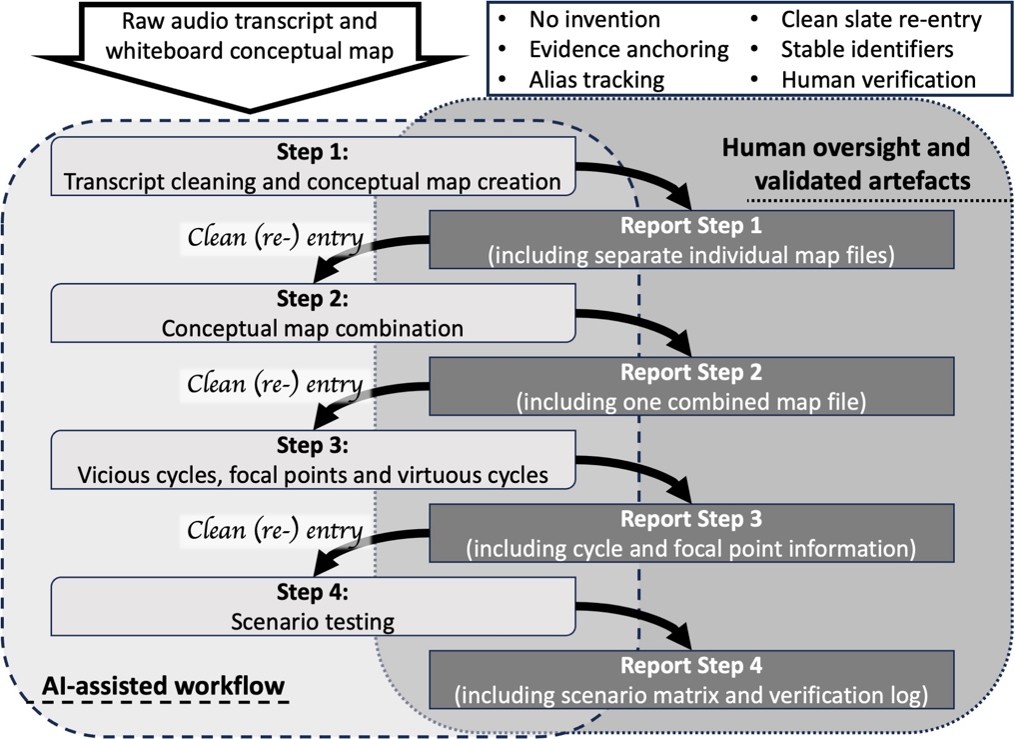
Participatory conceptual mapping is widely used in sustainability research to represent stakeholders’ knowledge, concerns, and perceptions of causal relationships within complex social-ecological systems. Yet translating workshop dialogue into reliable, auditable causal maps is labor-intensive and prone to interpretive drift. We present a four-step workflow combining guardrailed large language model (LLM) assistance with human oversight to transform workshop transcripts into DAPSI(W)R(M)-consistent conceptual maps, feedback structures, and qualitative scenarios. The workflow comprises (1) evidence-anchored extraction of nodes and directional links; (2) controlled merging of workshop maps into an identifier-stable representation; (3) identification of vicious cycles, focal points, and virtuous cycles using only the verified combined structure; and (4) scenario tracing through validated pathways. Guardrails include a no-invention rule, quotation-level evidence anchoring, alias tracking, stable identifiers, clean-slate re-entry, and human verification. Applied to two workshops on sustainable fisheries in Catalonia, Spain, the workflow consolidated 64 initial themes and 242 links into 43 themes and 243 verified relations. Three major vicious-cycle systems, several focal points, and twelve virtuous loops and chains informed ten stakeholder-style qualitative scenarios. The case study suggests that guardrailed LLM assistance can support synthesis of stakeholder-derived knowledge while keeping analytical decisions traceable. The workflow provides an auditable foundation for AI-supported participatory systems analysis and identifies future refinements including polarity checks, indicator integration, and empirically testable scenarios.
References
Elliott, M., Burdon, D., Atkins, J. P., Borja, Á., Cormier, R., de Jonge, V. N., & Turner, R. K. (2017). “And DPSIR begat DAPSI(W)R(M)!” – A unifying framework for marine environmental management. Marine Pollution Bulletin, 118(1-2), 27-40. https://doi.org/10.1016/j.marpolbul.2017.03.049
Hayward, J., Morton, S., Johnstone, M., Creighton, D., & Allender, S. (2020). Tools and analytic techniques to synthesise community knowledge in CBPR using computer-mediated participatory system modelling. npj Digital Medicine, 3, Article 22. https://doi.org/10.1038/s41746-020-0230-x
Hosseinichimeh, N., Majumdar, A., Williams, R., & Ghaffarzadegan, N. (2024). From text to map: A system dynamics bot for constructing causal loop diagrams. System Dynamics Review, 40(3), e1782. https://doi.org/10.1002/sdr.1782
Liu, N.-Y. G., & Keith, D. R. (2024). Leveraging Large Language Models for Automated Causal Loop Diagram Generation: Enhancing System Dynamics Modeling through Curated Prompting Techniques. In Proceedings of the 42nd International System Dynamics Conference. Extended abstract / Short paper. PDF available at: https://proceedings.systemdynamics.org/2024/papers/P1229.pdf
Liu, N.-Y. G., & Keith, D. R. (2025). Leveraging Large Language Models for Automated Causal Loop Diagram Generation: Enhancing System Dynamics Modeling through Curated Prompting Techniques. arXiv preprint. https://doi.org/10.48550/arXiv.2503.21798
Liu, A., & Sun, M. (2025). From Voices to Validity: Leveraging Large Language Models (LLMs) for Textual Analysis of Policy Stakeholder Interviews. AERA Open. https://doi.org/10.1177/23328584251374595
Liu, K., Yigitcanlar, T., Browne, W., & Fu, Y. (2025). Prompts for Planning AI Integration: Effective Prompt Design for Large Language Models in Support of Sustainable Urban Development [Preprint]. SSRN. https://papers.ssrn.com/sol3/papers.cfm?abstract_id=5323915
Manda, P. (2025). Large language models in bio-ontology research: A review. Bioengineering, 12(11), 1260. https://doi.org/10.3390/bioengineering12111260
Newberry, P., & Carhart, N. (2024). Constructing causal loop diagrams from large interview data sets. System Dynamics Review, 40(1), e1745. https://doi.org/10.1002/sdr.1745
Phatak, A., Agrawal, A., Mago, V. K., & Giabbanelli, P. J. (2024). Narrating Causal Graphs with Large Language Models. In Proceedings of the 57th Hawaii International Conference on System Sciences (HICSS-57) (pp. 7530-7539). PDF available at: https://scholarspace.manoa.hawaii.edu/server/api/core/bitstreams/ac123860-28e7-4b38-9ee4-88961e979b69/content
Powell, S., Copestake, J., & Remnant, F. (2024). Causal mapping for evaluators. Evaluation, 30(1), 100-119. https://doi.org/10.1177/13563890231196601
Quan, S. J., & Lee, S. (2025). Enhancing participatory planning with ChatGPT-assisted planning support systems: A hypothetical case study in Seoul. International Journal of Urban Sciences, 29(1), 89-122. https://doi.org/10.1080/12265934.2025.2462823
Reinholtz, K., Shahroudi, K. E., & Lawrence, S. (2025). LLM powered, expert refined causal loop diagramming via pipeline algebra. Systems, 13(9), 784. https://doi.org/10.3390/systems13090784
Rowe, E. C., Norton, L. R., McVittie, A., Watson, C. A., Wagner, M., Waterton, C., & Smith, L. G. (2025). Using fuzzy cognitive mapping to assess the sustainability impacts of transitioning to pasture-fed production in the UK beef sector. Renewable Agriculture and Food Systems, 40, e1. https://doi.org/10.1017/S1742170524000206
Sedlacko, M., Martinuzzi, A., Røpke, I., Videira, N., & Antunes, P. (2014). Participatory systems mapping for sustainable consumption: Discussion of a method promoting systemic insights. Ecological Economics, 106, 33-43. https://doi.org/10.1016/j.ecolecon.2014.07.002
Sharma, A., & Wallace, J. R. (2025). DeTAILS: Deep Thematic Analysis with Iterative LLM Support. In Proceedings of the 7th ACM Conference on Conversational User Interfaces (CUI ’25). ACM. https://doi.org/10.1145/3719160.3735657
Sharma, A., Cochrane, K., & Wallace, J. R. (2025). DeTAILS: Deep Thematic Analysis with Iterative LLM Support [Preprint]. arXiv preprint. https://arxiv.org/abs/2510.17575v2
White, J., & Barbrook-Johnson, P. (2025). Guidance on using large language models to extract cause and effect pairs from texts for systems mapping. CECAN & INET Oxford. CECAN report available at www.cecan.ac.uk/resources

This work is licensed under a Creative Commons Attribution-NonCommercial 4.0 International License.
Copyright (c) 2026 Maik Neukirch, Xavier Garcia, Elisa Berdalet, Aurelija Armoskaite, Giulia Bellon, Miriam von Thenen, Erasmia Kastanidi