

Keywords
early career scholars
computational research
best practices
workflows
How to Cite
Abstract
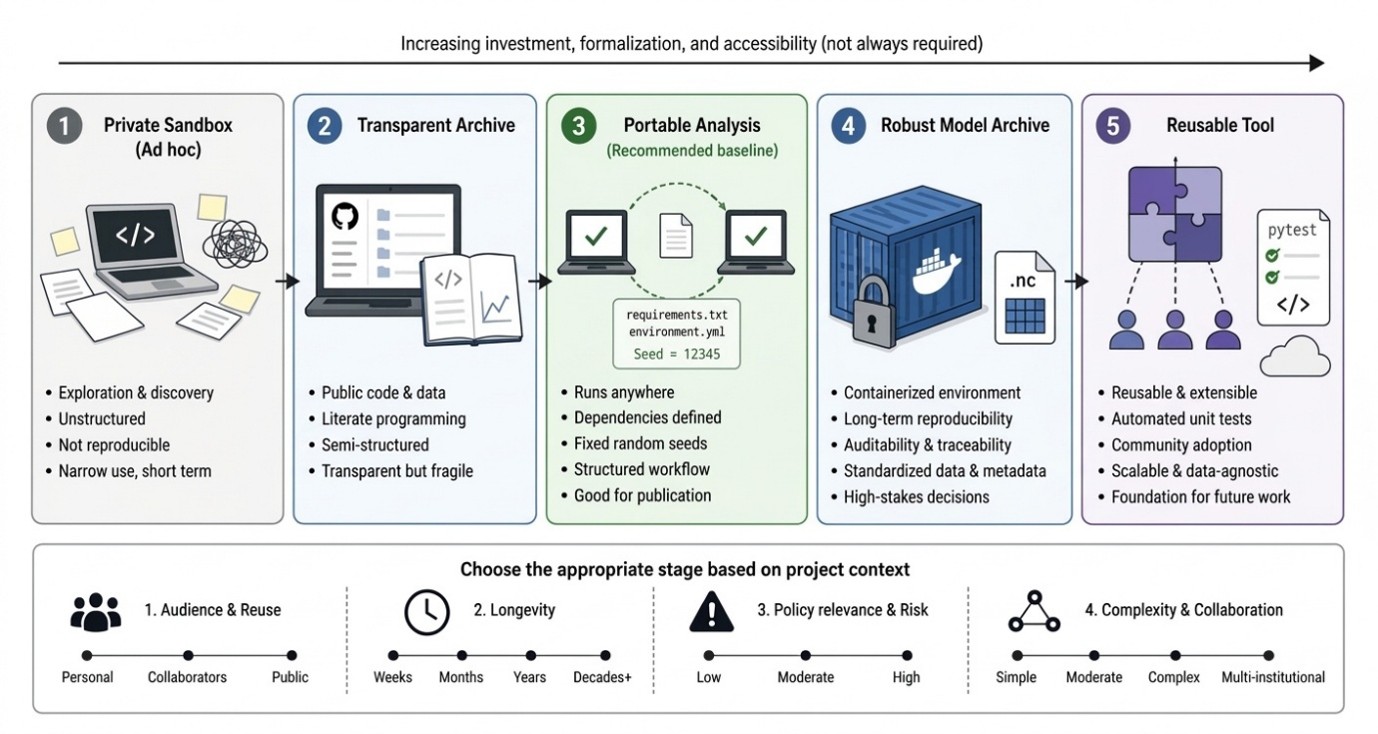
The expectation of "perfect" research reproducibility often acts as a deterrent rather than a catalyst for Early Career Scholars (ECSs) navigating the challenges of academia. Caught between the technical overhead of idealized workflows and the institutional pressure for publication velocity, ECSs require a pragmatic strategy that balances scientific rigor with the reality of finite resources. This paper provides that middle ground through a "good enough" framework for socio-environmental modelling, grounded in a fitness-for-purpose logic. We conceptualize reproducibility as a spectrum of five stages of computational reproducibility maturity, ranging from exploratory private sandboxes to reusable tools. Within this continuum, we identify Stage 3 (Portable Analysis) as the achievable and sufficient baseline for standard peer-reviewed research. To bridge the gap between theory and execution, we detail five foundational pillars – Documentation, Organization, Version Control, Self-Replication, and Sharing – and offer a tiered pre-submission checklist to help researchers verify their work. While providing ECSs with a technical roadmap, we emphasize that resolving the reproducibility crisis requires systemic shifts in how institutions and funding agencies resource the labor of transparency. Ultimately, this guide establishes a sustainable professional baseline for a new generation of modelers to produce work that is transparent, credible, and sustainable.
References
Allen, C., Mehler, D.M.A., 2019. Open science challenges, benefits and tips in early career and beyond. PLOS Biol. 17, e3000246. https://doi.org/10.1371/journal.pbio.3000246
Altmetric, 2016. Free Badges for Researchers. Altmetric. URL https://www.altmetric.com/products/free-tools/free-badges-for-researchers/ (accessed 2.26.23).
Ayllón, D., Railsback, S.F., Gallagher, C., Augusiak, J., Baveco, H., Berger, U., Charles, S., Martin, R., Focks, A., Galic, N., Liu, C., van Loon, E.E., Nabe-Nielsen, J., Piou, C., Polhill, J.G., Preuss, T.G., Radchuk, V., Schmolke, A., Stadnicka-Michalak, J., Thorbek, P., Grimm, V., 2021. Keeping modelling notebooks with TRACE: Good for you and good for environmental research and management support. Environ. Model. Softw. 136, 104932. https://doi.org/10.1016/j.envsoft.2020.104932
Baker, M., 2016. 1,500 scientists lift the lid on reproducibility. Nature 533, 452–454. https://doi.org/10.1038/533452a
Barciauskas, A., Mandel, A., Barron, K., Deziel, Z., 2023. Cloud-Optimized Geospatial Formats Guide [WWW Document]. Cloud-Optim. Geospatial Formats Guide. URL https://guide.cloudnativegeo.org/ (accessed 5.12.24).
Barnes, N., 2010. Publish your computer code: it is good enough. Nature 467, 753–753. https://doi.org/10.1038/467753a
Barton, C.M., Ames, D., Chen, M., Frank, K., Jagers, H.R.A., Lee, A., Reis, S., Swantek, L., 2022a. Making modeling and software FAIR. Environ. Model. Softw. 156, 105496. https://doi.org/10.1016/j.envsoft.2022.105496
Barton, C.M., Lee, A., Janssen, M.A., van der Leeuw, S., Tucker, G.E., Porter, C., Greenberg, J., Swantek, L., Frank, K., Chen, M., Jagers, H.R.A., 2022b. How to make models more useful. Proc. Natl. Acad. Sci. U.S.A. 119, e2202112119. https://doi.org/10.1073/pnas.2202112119
Becher, M.A., Grimm, V., Thorbek, P., Horn, J., Kennedy, P.J., Osborne, J.L., 2014. BEEHAVE: a systems model of honeybee colony dynamics and foraging to explore multifactorial causes of colony failure. J. Appl. Ecol. 51, 470–482. https://doi.org/10.1111/1365-2664.12222
Benz, J., Hoch, R., Legović, T., 2001. ECOBAS — modelling and documentation. Ecol. Model. 138, 3–15. https://doi.org/10.1016/S0304-3800(00)00389-6
Berger, U., Bell, A., Barton, C.M., Chappin, E., Dreßler, G., Filatova, T., Fronville, T., Lee, A., van Loon, E., Lorscheid, I., Meyer, M., Müller, B., Piou, C., Radchuk, V., Roxburgh, N., Schüler, L., Troost, C., Wijermans, N., Williams, T.G., Wimmler, M.-C., Grimm, V., 2024. Towards reusable building blocks for agent-based modelling and theory development. Environ. Model. Softw. 175, 106003. https://doi.org/10.1016/j.envsoft.2024.106003
Bhandari Neupane, J., Neupane, R.P., Luo, Y., Yoshida, W.Y., Sun, R., Williams, P.G., 2019. Characterization of Leptazolines A–D, Polar Oxazolines from the Cyanobacterium Leptolyngbya sp., Reveals a Glitch with the “Willoughby–Hoye” Scripts for Calculating NMR Chemical Shifts. Org. Lett. 21, 8449–8453. https://doi.org/10.1021/acs.orglett.9b03216
Brinckman, A., Chard, K., Gaffney, N., Hategan, M., Jones, M.B., Kowalik, K., Kulasekaran, S., Ludäscher, B., Mecum, B.D., Nabrzyski, J., Stodden, V., Taylor, I.J., Turk, M.J., Turner, K., 2019. Computing environments for reproducibility: Capturing the “Whole Tale.” Future Generation Computer Systems 94, 854–867. https://doi.org/10.1016/j.future.2017.12.029
Buckheit, J.B., Donoho, D.L., 1995. WaveLab and Reproducible Research, in: Antoniadis, A., Oppenheim, G. (Eds.), Wavelets and Statistics, Lecture Notes in Statistics. Springer New York, New York, NY, pp. 55–81. https://doi.org/10.1007/978-1-4612-2544-7_5
Call, M., 2022. Badges for Open Research Practices Now Available on OSF Registrations [WWW Document]. URL https://www.cos.io/blog/badges-for-open-research-practices-available-on-osf-registrations (accessed 7.23.23).
Chen, M., Voinov, A., Ames, D.P., Kettner, A.J., Goodall, J.L., Jakeman, A.J., Barton, M.C., Harpham, Q., Cuddy, S.M., DeLuca, C., Yue, S., Wang, J., Zhang, F., Wen, Y., Lü, G., 2020. Position paper: Open web-distributed integrated geographic modelling and simulation to enable broader participation and applications. Earth-Sci. Rev. 207, 103223. https://doi.org/10.1016/j.earscirev.2020.103223
Committee on Reproducibility and Replicability in Science, Board on Behavioral, Cognitive, and Sensory Sciences, Committee on National Statistics, Division of Behavioral and Social Sciences and Education, Nuclear and Radiation Studies Board, Division on Earth and Life Studies, Board on Mathematical Sciences and Analytics, Committee on Applied and Theoretical Statistics, Division on Engineering and Physical Sciences, Board on Research Data and Information, Committee on Science, Engineering, Medicine, and Public Policy, Policy and Global Affairs, National Academies of Sciences, Engineering, and Medicine, 2019. Reproducibility and Replicability in Science. National Academies Press, Washington, D.C. https://doi.org/10.17226/25303
Community Surface Dynamics Modeling System (CSDMS), 2026. Awards: Student Modeler Award.
Data Carpentry Committee, 2016. Introduction to Reproducible Research with `R`. Data Carpentry Committee. https://github.com/data-carpentry/rr-intro
Donoho, D., 2024. Data Science at the Singularity. Harv. Data Sci. Rev. 6.1. https://doi.org/10.1162/99608f92.b91339ef
Donoho, D.L., 2010. An invitation to reproducible computational research. Biostatistics 11, 385–388. https://doi.org/10.1093/biostatistics/kxq028
Edmonds, B., 2016. Review of The Aqua Book: Guidance on Producing Quality Analysis for Government [WWW Document]. URL https://jasss.soc.surrey.ac.uk/19/3/reviews/7.html (accessed 6.1.26).
Enserink, M., 2021. Does ocean acidification alter fish behavior? Fraud allegations create a sea of doubt [WWW Document]. Science.org. URL https://www.science.org/content/article/does-ocean-acidification-alter-fish-behavior-fraud-allegations-create-sea-doubt (accessed 1.21.24).
Esbaugh, A.J., 2023. Recalibrating the significance of the decline effect in fish ocean acidification research. PLOS Biol. 21, e3002113. https://doi.org/10.1371/journal.pbio.3002113
Fanelli, D., 2018. Is science really facing a reproducibility crisis, and do we need it to? Proc. Natl. Acad. Sci. 115, 2628–2631. https://doi.org/10.1073/pnas.1708272114
Filatova, T., Verbeek, L., Warnier, M., Ghorbani, A., Nikolic, I., Grimm, V., Berger, U., Barton, M., Bell, A., Lee, A., Magliocca, N.R., Wagenblast, T., 2025. AGENTBLOCKS: A Community Platform for Sharing, Comparing, and Improving Reusable Building Blocks for (Agent-Based) Models. J. Artif. Soc. Soc. Simul. 28, 11. https://doi.org/10.18564/jasss.5831
Fleischmann, M., Pons, S., 1989. Electrochemically induced nuclear fusion of deuterium. J. Electroanal. Chem. Interfacial Electrochem. 261, 301–308. https://doi.org/10.1016/0022-0728(89)80006-3
Grimm, V., 2023. Ecology needs to overcome siloed modelling. Trends Ecol. Evol. 38, 1122–1124. https://doi.org/10.1016/j.tree.2023.09.011
Grimm, V., Berger, U., Bastiansen, F., Eliassen, S., Ginot, V., Giske, J., Goss-Custard, J., Grand, T., Heinz, S.K., Huse, G., Huth, A., Jepsen, J.U., Jørgensen, C., Mooij, W.M., Müller, B., Pe’er, G., Piou, C., Railsback, S.F., Robbins, A.M., Robbins, M.M., Rossmanith, E., Rüger, N., Strand, E., Souissi, S., Stillman, R.A., Vabø, R., Visser, U., DeAngelis, D.L., 2006. A standard protocol for describing individual-based and agent-based models. Ecol. Model. 198, 115–126. https://doi.org/10.1016/j.ecolmodel.2006.04.023
Grimm, V., Railsback, S.F., Vincenot, C.E., Berger, U., Gallagher, C., DeAngelis, D.L., Edmonds, B., Ge, J., Giske, J., Groeneveld, J., Johnston, A.S.A., Milles, A., Nabe-Nielsen, J., Polhill, J.G., Radchuk, V., Rohwäder, M.-S., Stillman, R.A., Thiele, J.C., Ayllón, D., 2020. The ODD protocol for describing agent-based and other simulation models: a second update to improve clarity, replication, and structural realism. J. Artif. Soc. Soc. Simul. 23, 7. https://doi.org/10.18564/jasss.4259
Hamilton, S.H., Pollino, C.A., Stratford, D.S., Fu, B., Jakeman, A.J., 2022. Fit-for-purpose environmental modeling: Targeting the intersection of usability, reliability and feasibility. Environ. Model. Softw. 148, 105278. https://doi.org/10.1016/j.envsoft.2021.105278
Higginson, A.D., Munafò, M.R., 2016. Current Incentives for Scientists Lead to Underpowered Studies with Erroneous Conclusions. PLOS Biol. 14, e2000995. https://doi.org/10.1371/journal.pbio.2000995
HM Treasury, 2015. Aqua Book: Guidance on producing quality analysis for government.
Hong, N.P.C., Crick, T., Gent, I.P., Kotthoff, L., Takeda, K., 2015. Top Tips to Make Your Research Irreproducible. https://doi.org/10.48550/arXiv.1504.00062
Hutton, C., Wagener, T., Freer, J., Han, D., Duffy, C., Arheimer, B., 2016. Most computational hydrology is not reproducible, so is it really science? Water Resour. Res. 52, 7548–7555. https://doi.org/10.1002/2016WR019285
Hutton, E.W.H., Piper, M.D., Tucker, G.E., 2020. The Basic Model Interface 2.0: A standard interface for coupling numerical models in the geosciences. J. Open Source Softw. 5, 2317. https://doi.org/10.21105/joss.02317
Huxley, A., Jones, S., Bradshaw, D., 1994. The human situation: lectures at Santa Barbara, 1959, Flamingo modern classic. Flamingo, London.
Ioannidis, J.P.A., 2005. Why Most Published Research Findings Are False. PLOS Med. 2, 2–8. https://doi.org/10.1371/journal.pmed.0020124
Iwanaga, T., Wang, H.-H., Hamilton, S.H., Grimm, V., Koralewski, T.E., Salado, A., Elsawah, S., Razavi, S., Yang, J., Glynn, P., Badham, J., Voinov, A., Chen, M., Grant, W.E., Peterson, T.R., Frank, K., Shenk, G., Barton, C.M., Jakeman, A.J., Little, J.C., 2021a. Socio-technical scales in socio-environmental modeling: Managing a system-of-systems modeling approach. Environ. Model. Softw. 135, 104885. https://doi.org/10.1016/j.envsoft.2020.104885
Iwanaga, T., Wang, H.-H., Koralewski, T.E., Grant, W.E., Jakeman, A.J., Little, J.C., 2021b. Toward a complete interdisciplinary treatment of scale: Reflexive lessons from socioenvironmental systems modeling. Elem. Sci. Anthr. 9. https://doi.org/10.1525/elementa.2020.00182
James, S.R., Foks, N.L., Minsley, B.J., 2022. GSPy: A new toolbox and data standard for Geophysical Datasets. Front. Earth Sci. 10. https://doi.org/10.3389/feart.2022.907614
Jebeile, J., Crucifix, M., 2020. Multi-model ensembles in climate science: Mathematical structures and expert judgements. Stud. Hist. Philos. Sci. Part A 83, 44–52. https://doi.org/10.1016/j.shpsa.2020.03.001
Jenkins, G.B., Beckerman, A.P., Bellard, C., Benítez-López, A., Ellison, A.M., Foote, C.G., Hufton, A.L., Lashley, M.A., Lortie, C.J., Ma, Z., Moore, A.J., Narum, S.R., Nilsson, J., O’Boyle, B., Provete, D.B., Razgour, O., Rieseberg, L., Riginos, C., Santini, L., Sibbett, B., Peres-Neto, P.R., 2023. Reproducibility in ecology and evolution: Minimum standards for data and code. Ecol. Evol. 13, e9961. https://doi.org/10.1002/ece3.9961
Kidwell, M.C., Lazarević, L.B., Baranski, E., Hardwicke, T.E., Piechowski, S., Falkenberg, L.-S., Kennett, C., Slowik, A., Sonnleitner, C., Hess-Holden, C.L., Errington, T., Timothy M Errington, Fiedler, S., Brian A. Nosek, Nosek, B.A., Brian A. Nosek, 2016. Badges to Acknowledge Open Practices: A Simple, Low-Cost, Effective Method for Increasing Transparency. PLoS Biol. 14(5), e1002456. https://doi.org/10.1371/journal.pbio.1002456
Kim, Y.-M., Poline, J.-B., Dumas, G., 2018. Experimenting with reproducibility: a case study of robustness in bioinformatics. GigaScience 7, giy077. https://doi.org/10.1093/gigascience/giy077
Kohrs, F.E., Auer, S., Bannach-Brown, A., Fiedler, S., Haven, T.L., Heise, V., Holman, C., Azevedo, F., Bernard, R., Bleier, A., Bössel, N., Cahill, B.P., Castro, L.J., Ehrenhofer, A., Eichel, K., Frank, M., Frick, C., Friese, M., Gärtner, A., Gierend, K., Grüning, D.J., Hahn, L., Hülsemann, M., Ihle, M., Illius, S., König, L., König, M., Kulke, L., Kutlin, A., Lammers, F., Mehler, D.M., Miehl, C., Müller-Alcazar, A., Neuendorf, C., Niemeyer, H., Pargent, F., Peikert, A., Pfeuffer, C.U., Reinecke, R., Röer, J.P., Rohmann, J.L., Sánchez-Tójar, A., Scherbaum, S., Sixtus, E., Spitzer, L., Straßburger, V.M., Weber, M., Whitmire, C.J., Zerna, J., Zorbek, D., Zumstein, P., Weissgerber, T.L., 2023. Eleven strategies for making reproducible research and open science training the norm at research institutions. eLife 12, e89736. https://doi.org/10.7554/eLife.89736
Kondyli, D., Nisiotis, C.-S., Klironomos, N., 2024. Data reusability for migration research: a use case from SoDaNet data repository. Front. Hum. Dyn. 5, 1310420. https://doi.org/10.3389/fhumd.2023.1310420
Kruchten, P., 2008. What do software architects really do? J. Syst. Softw. 81, 2413–2416. https://doi.org/10.1016/j.jss.2008.08.025
Lagisz, M., Aich, U., Amin, B., Rutkowska, J., Sánchez-Mercado, A., Lara, C.E., Nakagawa, S., 2023. Little transparency and equity in scientific awards for early- and mid-career researchers in ecology and evolution. Nat. Ecol. Evol. 7, 655–665. https://doi.org/10.1038/s41559-023-02028-6
Leek, J.T., Jager, L., 2016. Is most published research really false. bioRxiv 050575. https://doi.org/10.1101/050575
Leipzig, J., Nüst, D., Hoyt, C.T., Ram, K., Greenberg, J., 2021. The role of metadata in reproducible computational research. 2, 100322. https://doi.org/10.1016/j.patter.2021.100322
LeVeque, R.J., Mitchell, I.M., Stodden, V., 2012. Reproducible research for scientific computing: Tools and strategies for changing the culture. Comput. Sci. Eng. 14, 13–17. https://doi.org/10.1109/mcse.2012.38
Little, J.C., Hester, E.T., Elsawah, S., Filz, G.M., Sandu, A., Carey, C.C., Iwanaga, T., Jakeman, A.J., 2019. A tiered, system-of-systems modeling framework for resolving complex socio-environmental policy issues. Environ. Model. Softw. 112, 82–94. https://doi.org/10.1016/j.envsoft.2018.11.011
McConnell, S., 2004. Code Complete, Second Edition, 2nd ed. Pearson Education.
McIntire, E.J.B., Chubaty, A.M., Cumming, S.G., Andison, D., Barros, C., Boisvenue, C., Haché, S., Luo, Y., Micheletti, T., Stewart, F.E.C., 2022. PERFICT: A Re-imagined foundation for predictive ecology. Ecol. Lett. 25, 1345–1351. https://doi.org/10.1111/ele.13994
Meirmans, S., Butlin, R.K., Charmantier, A., Engelstädter, J., Groot, A.T., King, K.C., Kokko, H., Reid, J.M., Neiman, M., 2019. Science policies: How should science funding be allocated? An evolutionary biologists’ perspective. J. Evol. Biol. 32, 754–768. https://doi.org/10.1111/jeb.13497
Melsen, L.A., Teuling, A.J., Torfs, P.J.J.F., Zappa, M., Mizukami, N., Mendoza, P.A., Clark, M.P., Uijlenhoet, R., 2019. Subjective modeling decisions can significantly impact the simulation of flood and drought events. J. Hydrol. 568, 1093–1104. https://doi.org/10.1016/j.jhydrol.2018.11.046
Melsen, L.A., Torfs, P.J.J.F., Uijlenhoet, R., Teuling, A.J., 2017. Comment on “Most computational hydrology is not reproducible, so is it really science?” by Christopher Hutton et al. Water Resour. Res. 53, 2568–2569. https://doi.org/10.1002/2016WR020208
Micheletti, T., Wimmler, M.-C., Berger, U., Grimm, V., McIntire, E.J., 2024. Beyond guides, protocols and acronyms: Adoption of good modelling practices depends on challenging academia’s status quo in ecology. Ecol. Model. 496, 110829. https://doi.org/10.1016/j.ecolmodel.2024.110829
Moreau, D., Wiebels, K., Boettiger, C., 2023. Containers for computational reproducibility. Nat. Rev. Methods Primer 3, 50. https://doi.org/10.1038/s43586-023-00236-9
Nüst, D., Granell, C., Hofer, B., Konkol, M., Ostermann, F.O., Sileryte, R., Cerutti, V., 2018. Reproducible research and GIScience: an evaluation using AGILE conference papers. PeerJ 6, 1–23. https://doi.org/10.7717/peerj.5072
Obokata, H., Wakayama, T., Sasai, Y., Kojima, K., Vacanti, M.P., Niwa, H., Yamato, M., Vacanti, C.A., 2014. Retraction Note: Stimulus-triggered fate conversion of somatic cells into pluripotency. Nature 511, 112–112. https://doi.org/10.1038/nature13598
Open Science Collaboration. Estimating the reproducibility of psychological science. Science 349, 943–943. https://doi.org/10.1126/science.aac4716
Pellizzari, E., Lohr, K., Blatecky, A., Creel, D., 2017. Reproducibility: A Primer on Semantics and Implications for Research. RTI Press. https://doi.org/10.3768/rtipress.2017.bk.0020.1708
Plesser, H.E., 2018. Reproducibility vs. Replicability: A Brief History of a Confused Terminology. Front. Neuroinformatics 11, 76–76. https://doi.org/10.3389/fninf.2017.00076
Poldrack, R.A., 2019. The Costs of Reproducibility. Neuron 101, 11–14. https://doi.org/10.1016/j.neuron.2018.11.030
Popper, K.R., 1959. The logic of scientific discovery, 2008 reprint. ed. Routledge, London ; New York.
Rekha V, S., Muccini, H., 2018. Group decision-making in software architecture: A study on industrial practices. Inf. Softw. Technol. 101, 51–63. https://doi.org/10.1016/j.infsof.2018.04.009
Saltelli, A., 2018. Why science’s crisis should not become a political battling ground. Futures 104, 85–90. https://doi.org/10.1016/j.futures.2018.07.006
Saltelli, A., Aleksankina, K., Becker, W., Fennell, P., Ferretti, F., Holst, N., Li, S., Wu, Q., 2019. Why So Many Published Sensitivity Analyses Are False: A Systematic Review of Sensitivity Analysis Practices. Environ. Model. Softw. 114, 29–39.
Saltelli, A., Funtowicz, S., 2017. What is science’s crisis really about? Futures, Post-Normal science in practice 91, 5–11. https://doi.org/10.1016/j.futures.2017.05.010
Sandve, G.K., Nekrutenko, A., Taylor, R.J., Hovig, E., 2013. Ten simple rules for reproducible computational research. PLOS Comput. Biol. 9(10). https://doi.org/10.1371/journal.pcbi.1003285
Schnell, S., 2018. “Reproducible” Research in Mathematical Sciences Requires Changes in our Peer Review Culture and Modernization of our Current Publication Approach. Bull. Math. Biol. 80, 3095–3105. https://doi.org/10.1007/s11538-018-0500-9
Schuwirth, N., Borgwardt, F., Domisch, S., Friedrichs, M., Kattwinkel, M., Kneis, D., Kuemmerlen, M., Langhans, S.D., Martínez-López, J., Vermeiren, P., 2019. How to make ecological models useful for environmental management. Ecol. Model. 411, 108784. https://doi.org/10.1016/j.ecolmodel.2019.108784
Seppelt, R., Richter, O., 2005. “It was an artefact not the result”: A note on systems dynamic model development tools. Environ. Model. Softw., Environmental Knowledge and Information Systems 20, 1543–1548. https://doi.org/10.1016/j.envsoft.2004.12.004
Samuel, S., König-Ries, B., 2021. Understanding experiments and research practices for reproducibility: an exploratory study. PeerJ 9, e11140. https://doi.org/10.7717/peerj.11140
Simmons, A.J., Barnett, S., Rivera-Villicana, J., Bajaj, A., Vasa, R., 2020. A large-scale comparative analysis of Coding Standard conformance in Open-Source Data Science projects, in: Proceedings of the 14th ACM / IEEE International Symposium on Empirical Software Engineering and Measurement (ESEM). Presented at the ESEM ’20: ACM / IEEE International Symposium on Empirical Software Engineering and Measurement, ACM, Bari Italy, pp. 1–11. https://doi.org/10.1145/3382494.3410680
Sletholt, M.T., Hannay, J.E., Pfahl, D., Langtangen, H.P., 2012. What do we know about scientific software development’s agile practices? Computing in Science & Engineering 14(2), 24–36. https://doi.org/10.1109/MCSE.2011.113
Stodden, V., 2010. The Scientific Method in Practice: Reproducibility in the Computational Sciences. https://doi.org/10.2139/ssrn.1550193
Stodden, V., Seiler, J., Ma, Z., 2018. An empirical analysis of journal policy effectiveness for computational reproducibility. Proc. Natl. Acad. Sci. U. S. A. 115, 2584–2589. https://doi.org/10.1073/pnas.1708290115
Theiler, J., 1990. Estimating Fractal Dimension. J Opt Soc Am A 7, 1055–1073.
Vines, T.H., Albert, A., Andrew, R.L., Débarre, F., Bock, D.G., Franklin, M.T., Gilbert, K.J., Prunier, J.G., Moore, J.-S., Renaut, S., Rennison, D.J., 2014. The Availability of Research Data Declines Rapidly with Article Age. Curr. Biol. 24, 94–97. https://doi.org/10.1016/j.cub.2013.11.014
Wang, T., Wang, S., Chen, T.-H. (Peter), 2023. Study the correlation between the readme file of GitHub projects and their popularity. J. Syst. Softw. 205, 111806. https://doi.org/10.1016/j.jss.2023.111806
Williams, M., Mullane, K., Curtis, M.J., 2018. Addressing Reproducibility: Peer Review, Impact Factors, Checklists, Guidelines, and Reproducibility Initiatives, In: Research in the Biomedical Sciences. Elsevier, pp. 197–306. https://doi.org/10.1016/b978-0-12-804725-5.00005-7
Wilson, G., Aruliah, D.A., Brown, C.T., Hong, N.P.C., Davis, M., Guy, R.T., Haddock, S.H.D., Huff, K.D., Mitchell, I.M., Plumbley, M.D., Waugh, B., White, E.P., Wilson, P., 2014. Best Practices for Scientific Computing. PLOS Biol. 12, e1001745. https://doi.org/10.1371/journal.pbio.1001745
Wilson, J.P., Butler, K., Gao, S., Hu, Y., Li, W., Wright, D.J., 2021. A Five-Star Guide for Achieving Replicability and Reproducibility When Working with GIS Software and Algorithms. Ann. Am. Assoc. Geogr. 111(5), 1311-1317. https://doi.org/10.1080/24694452.2020.1806026
Wirtz, D., Nowak, W., 2017. The rocky road to extended simulation frameworks covering uncertainty, inversion, optimization and control. Environ. Model. Softw. 93, 180–192. https://doi.org/10.1016/j.envsoft.2016.10.003
Zhu, Z., Chen, M., Sun, L., Qian, Z., He, Y., Ma, Z., Zhang, F., Wen, Y., Yue, S., Lü, G., 2023. Reproducing computational processes in service-based geo-simulation experiments. Int. J. Appl. Earth Obs. Geoinformation 124, 103520. https://doi.org/10.1016/j.jag.2023

This work is licensed under a Creative Commons Attribution-NonCommercial 4.0 International License.
Copyright (c) 2026 Takuya Iwanaga, Jazmin Zatarain Salazar, Nianhua Liu, Zhiyi Zhu, Radmila Jovanovic, Liang-Jun Zhu, Hugo Salinas, Ismael Garcia, Tatiane Micheletti